How to Read Morse Code | Learn to Read & Write
Reading Morse code may seem difficult at first, but once you understand the patterns, it becomes a simple and practical skill. How to read Morse code is a common question for beginners who want to learn this classic communication method. Morse code uses short and long signals, known as dots and dashes, to represent letters, numbers, and words. These signals can be sent through sound, light, or tapping, making Morse code useful in many real-world situations.
Many people learn it for emergency use, amateur radio, or just to build a new skill. The key is to focus on timing, patterns, and regular practice instead of trying to memorize everything at once. In this guide, you will learn clear methods to read Morse code step by step, including charts, signals, and practical exercises that help you improve accuracy and speed over time.
How to Read Morse Code for Beginners

If you are a beginner, the key is to start simple. Focus on letters that appear most frequently, like E (dot) and T (dash). Gradually move on to other letters as you build confidence.
Here’s a basic routine for beginners:
- Learn 5 letters at a time, repeating each letter aloud while tapping or listening to its signal.
- Combine learned letters to form short words like HI, CAT, or DOG.
- Practice decoding small messages daily for 10–15 minutes.
- Test your speed by translating increasingly complex words.
Avoid trying to memorize the whole alphabet at once. Focused practice on small groups of letters produces faster results.
Using a Morse Code Chart for Easy Learning
A morse code chart is essential for beginners. Charts show each letter and number along with its corresponding dots and dashes.
To use a chart effectively:
Learning with a chart develops your visual and mental recognition of Morse patterns. Combining chart study with listening or tapping exercises strengthens memory retention.
Reading Morse Code Numbers Alongside Letters
Five-signal sequences represent numbers in Morse code. For example:
| Number | Morse Code | Pattern Tip |
|---|---|---|
| 1 | .—- | 1 dot + 4 dashes |
| 2 | ..— | 2 dots + 3 dashes |
| 3 | …– | 3 dots + 2 dashes |
| 4 | ….- | 4 dots + 1 dash |
| 5 | ….. | 5 dots |
| 6 | -…. | 1 dash + 4 dots |
| 7 | –… | 2 dashes + 3 dots |
| 8 | —.. | 3 dashes + 2 dots |
| 9 | —-. | 4 dashes + 1 dot |
| 0 | —– | 5 dashes |
Learning morse code numbers is essential because messages often include coordinates, dates, or emergency codes. Begin by memorizing 1–5 first, then 6–0. Practice combining numbers with letters to read full messages.
Example exercise: Decode this sequence: …. . .-.. .-.. — / .—- ..— …–
Answer: “HELLO 123”
How to Read Morse Code With Lights
Visual signals are widely used for Morse code when sound is not possible. How to read morse code with lights involves observing short flashes for dots and longer flashes for dashes.
Tips for beginners:
Example: SOS in lights is … — … – three short, three long, three short flashes. Practicing with lights trains your eyes to decode messages accurately.
How to Read Morse Code Blinking Signals
How to read morse code blinking is similar to using lights but requires more focus on timing. Each blink corresponds to a dot or dash, and the pause between blinks indicates separation of letters and words.
Tips:
Exercise: Blink the word “HELP” using dots and dashes. Have someone else decode it, then switch roles. This improves pattern recognition and reaction time.
Using a Morse Code Translator for Practice
A morse code translator is a digital tool that converts letters into Morse code and vice versa. Translators help beginners verify accuracy while practicing decoding and encoding.
Benefits of using a translator:
Combine translator use with manual practice. Translators are helpful, but relying on them exclusively slows real-life skill development.
Tips for Faster Learning and Accuracy
To read Morse code efficiently:
Avoid common mistakes like ignoring pauses between letters and words or practicing too many letters at once. Accuracy is more important than speed in the beginning.
Real-World Applications of Morse Code Today
Morse code remains useful in multiple real-world situations:
Understanding practical uses gives motivation to continue learning and makes the skill relevant in modern contexts.
How to read morse code – Timing rules
Learning morse code through sound is easier than reading; therefore, it is better to learn through sound first and then associate it with reading alphabets and words.
This information is crucial in learning Morse code blinking.
How to practice Morse Code?
Some of the effective techniques to practice morse code language are given as:
- First of all, familiarise yourself with the Morse Code alphabet, numbers, and their corresponding codes. You can do this with the help of Morse Code Translator. Practice by writing so that you can recall the codes effortlessly.
- Avail online resources to practice the tutorials and exercises. To reinforce learning, attempt quizzes, lessons, and games related to morse code.
- One of the effective ways to practice Morse code is by using flashcards regularly. Letters and numbers can be written on one side, whereas their corresponding characters on the other side. Use them regularly to improve recognition.
- Listen to the recordings of morse code patterns and beeps that are available online. You can start with a slower speed and increase the speed once you familiarise yourself. Listening to dits and dahs of the morse codes is the most effective way to learn morse code.
- Finally, write and rewrite the code to enhance your practice.
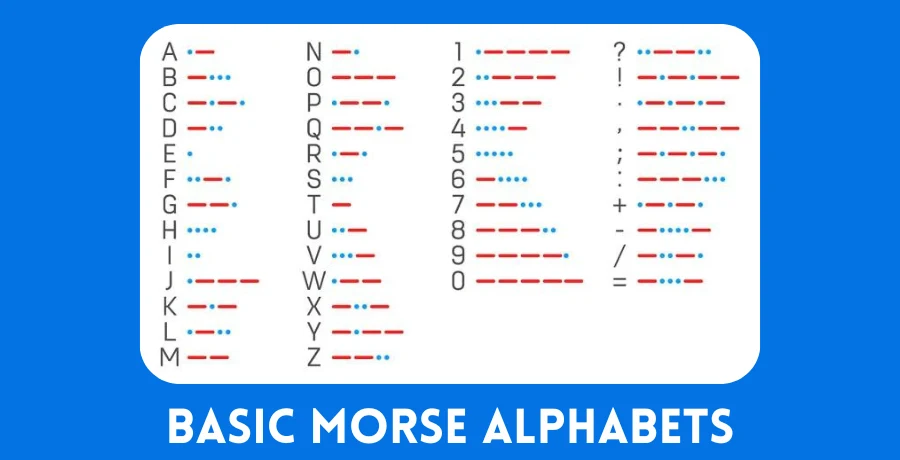
How to write Morse Code?
Useful Morse code phrases
These are some of the common morse code phrases that you should learn to read.
Conclusion
Learning how to read morse code is not as complex as it first appears. It becomes easier when you focus on patterns, timing, and consistent practice. Start with basic letters and numbers, then move to full words and short messages. Using charts, light signals, and simple exercises helps build both speed and accuracy over time.
Methods like blinking lights and tapping also make Morse code practical in real-life situations where sound is not available. The key is to stay consistent and avoid rushing the learning process. With daily practice, you will begin to recognize signals naturally without needing to think about each dot and dash.
In the end, Morse code is a skill that combines logic and rhythm. Once you understand the system, reading and decoding messages becomes faster and more intuitive.