Morse Code Translator | Decode & Encode Morse Code Online with Audio
Options
Morse Code Alphabet
Letters
| A | .- | B | -... | C | -.-. |
| D | -.. | E | . | F | ..-. |
| G | --. | H | .... | I | .. |
| J | .--- | K | -.- | L | .-.. |
| M | -- | N | -. | O | --- |
| P | .--. | Q | --.- | R | .-. |
| S | ... | T | - | U | ..- |
| V | ...- | W | .-- | X | -..- |
| Y | -.-- | Z | --.. |
Numbers
| 0 | ----- | 1 | .---- | 2 | ..--- |
| 3 | ...-- | 4 | ....- | 5 | ..... |
| 6 | -.... | 7 | --... | 8 | ---.. |
| 9 | ----. |
Punctuation
| . | .-.-.- | , | --..-- | ? | ..--.. |
| ' | .----. | ! | -.-.-- | / | -..-. |
| ( | -.--. | ) | -.--.- | & | .-... |
| : | ---... | ; | -.-.-. | = | -...- |
| + | .-.-. | - | -....- | _ | ..--.- |
| " | .-..-. | $ | ...-..- | @ | .--.-. |
| ¿ | ..-.- | ¡ | --...- |
Want to decode or encode your messages quickly without memorizing patterns, making mistakes, or using complex tools? If yes, then a Morse Code Translator is your go-to choice for instant conversion between plain text and International Morse Code with accuracy and ease.
Morse Code represents letters, numbers, and symbols using structured signal patterns that can be transmitted through sound, light, or radio waves. These translators are widely used in amateur radio, survival training, education, and puzzles. They are also useful for simple encryption when creating hidden or coded messages.
In this comprehensive guide, we are going to explain everything about Morse Code Translator, including its features, common codes, how it works, and how to use it effectively. But before that its crucial to know what Morse Code Translator is? So, let’s begin.
What is a Morse Code Translator?
It is an efficient online tool that translates Morse code within in few seconds. It is helpful for those who are not familiar with the Morse alphabet table and want to save time instead of learning to read the table. With a Morse code translator and reader, anyone can translate the code into English language or any other language. Morse code converter converts dashes and punctuation marks into English sentences or words or other languages that you choose. Our converter can encode as well as decode morse code. Encode means it converts text into morse code whereas decode means converting code into the original text.
What Is Morse Code?
Morse Code is a encoding system developed in the 1830s for telegraph networks. It converts text into patterns of dots and dashes for efficient data transmission.
It was used for long distance communication over wires and later expanded into radio communication, maritime, and aviation systems. It works through sound, light, radio waves, or tapping signals.
Developed by Samuel Morse and Alfred Vail, it remains a simple and reliable method, now supported by modern tools for fast decoding and learning.
How to Use a Morse Code Translator?
A Morse Code Translator is a simple tool that converts text into Morse Code and back without requiring you to memorize patterns. It automates both encoding and decoding, making communication faster, more accurate, and accessible. You have no need for complicated setup, downloading any third party tools. From simple words to emergency signals, every word can be decoded effortlessly with in a few seconds. Yeah! I’m not kidding. Let’s learn it.
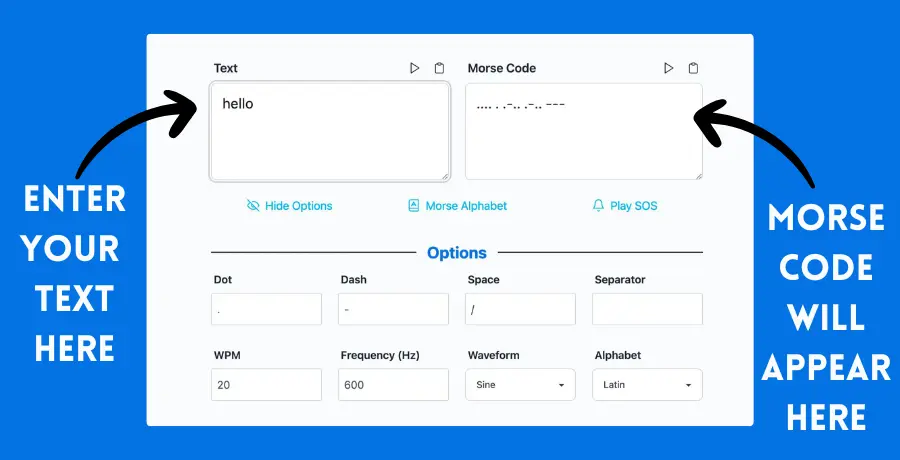
Step 1: Enter Your Text
First and foremost enter your text or a Morse Symbol to which you want to convert. Whether you enter plain text or dot and dash sequences, the translator will recognize and convert it instantly.
Step 2: Instant Translation
As you enter words or any pattern the tool’s advanced mechanism understands your input and automatically translate it. Isn’t it exciting for you?
Step 3: Listen and Learn
One of the most fun elements is our tool allows you listen and learn to bot your text and morse code. For this you just have to click the “Play” Button.
Step 4: Customize Settings
The charm of Morse Code Translator lies in its customizable setting. Yeah! You can adjust settings such as WPM, tone frequency, and waveform to control output. These options influence how signals are generated and perceived. All of these incredible options significantly allows to optimize performance in different communication systems.
Note: Morse Code Translator is not merely a tool but it also opens an array of possibilities for you. Yeah you can copy Morse code, or your text instantly, customize settings, listen and learn sounds. Saying this would not be wrong that it is an all in one hub.
Why Was Morse Code Used?
It was mostly used in wars to stay informed as well as to bring families together through these messages. Even today it is required to be learned by Naval intelligence trainees and is accepted as a universal communication method. It is used in amateur radio, aviation, and emergency services. Some may also keep the apparatus for the hobby and nostalgia. It is still used in films and software programs.
Today’s Morse code encoder is slightly different from the original and is called international Morse code which is also easier to use. Its official use is almost diminished but many still use it due to its reliability and simplicity. The advantage of using this technique is that it requires minimal technology and comes in handy in low-tech environments.
It works efficiently over vast distances and it is effective in challenging situations. One of the most effective and commonly used messages was Morse code SOS “… ___ …” which is a message requesting help and literally translating into “Save Our Souls”.
Hands-On Morse Code Translator in Seconds
The modern translators are designed for speed and ease of use. When you enter text in the input box, the system instantly translates it into Morse code using dots and dashes.
The above tools can be used as a morse code converter. They can translate normal text into Morse code without using a code chart. This makes learning much easier and avoids the frustration that people face when trying to learn how to decode a message.
Superlative Features Morse Code Translator
A well-designed translator does more than simple conversion. It includes several features that make learning easier and communication faster.
Convert Text to Morse Code
This feature enables you to transform normal writing into Morse code patterns. You can do this by simply typing your text, and you will get the dots and dashes instantly. This is commonly called text to morse code conversion.
For new learners, this feature can be helpful since it reinforces their learning. This is because, after typing a word, you can instantly see the pattern of the word.
Translate Morse Code to Text
The interpretation of the morse code by hand can be challenging, especially for new users. A digital tool can solve the problem by instantly converting the code back to the original language.
The process can be described as morse code to text conversion. The user can enter the morse code, and the sentence will be displayed immediately.
Copy and Share Instantly
After translating your message, you can copy the Morse code and share it with others via messaging apps, emails, or social media sites. This is a great way to secretly communicate with your friends.
Some people love to send secret messages such as “i love you” in Morse code, which consists of a series of dots and dashes that only a Morse code expert can understand.
Generate Random Messages
Learning is easier if practice is regular. Random message generators are used to generate practice messages for the learner.
Morse code generation is a feature that allows a random pattern or sentence in Morse code to be created, helping learners practice decoding without repeating the same word over and over again.
Play Morse Code Audio
One of the original forms of sending Morse Code messages was through sound. Many translators now include an audio play option so the person can hear the sound of the messages.
This feature is similar to an audio system for the morse code translator, allowing the person to hear the sound of the dots and dashes.
Visual Light Playback
Another interesting feature is visual sign language. Instead of sound, the translator flashes light signals indicating dots and dashes. This is a simulation of how people communicate during a survival situation or on a ship.
Sound Configuration and Customization
Advanced tools enable users to change tone, speed, and style of audio signals. Beginners start with slow signals, while experts increase signal speed for better results.
Custom settings enable users to adjust the learning process according to their skill levels. All of these small features allow the user to monitor progress as well as enhance
Real-Time Feedback and Counters
Good translators offer real-time feedback. As the user types in the messages or decodes the messages, the system will offer feedback in the form of the number of characters entered, the timing of the signals, and the accuracy of the translation.
How to Read and Write Morse Code?
To read Morse code, one must understand how spacing is used. A short pause is used between a dot and a dash for a single letter, and a bit longer pause is used between letters. Finally, a longer pause is used between words.
To write Morse code, one must apply these same rules, but in reverse. This means that each letter must be translated into its appropriate code. A digital reader can be used to aid a novice in reading Morse code while they are learning these spacing rules.
Learn Morse Code Step by Step
Learning Morse code does not require memorizing the entire system in one day. Start with common letters and gradually expand your knowledge.
Practice regularly with short messages. Over time, patterns become easier to recognize and decoding speed improves. Using a morse decoder alongside practice exercises helps beginners verify their translations and learn from mistakes.
Modern Uses of Morse Code
Morse code is still useful in a world with smartphones and satellite communications. Amateur radio operators use it for long-distance communications, and survival experts teach it as a form of emergency signaling. Pilots and sailors use it in navigation systems too. Morse code is still useful because it requires little equipment and can be sent over a number of mediums.
Why Morse Code Still Matters Today?
Morse code remains valuable because it is simple, reliable, and adaptable. A signal can be sent through sound, light, radio, or even tapping on a surface.This flexibility makes Morse communication useful in emergencies where advanced technology may fail. Knowing english to morse code translation can help someone send signals when other communication methods are unavailable.
Common Morse Code Sentences
The first Morse code message sent through a telegraph line was “What hath God wrought”. It was transmitted on 24 May 1844 during the first successful telegraph demonstration. After that moment, Morse code quickly became a widely used signaling system for long-distance messaging.
Over time, several short and recognizable words became common in Morse communication because they are easy to transmit and understand.
| Word / Phrase | Morse Code |
|---|---|
| SOS (Distress Signal) | ... --- ... |
| HELLO | .... . .-.. .-.. --- |
| HELP | .... . .-.. .--. |
| YES | -.-- . ... |
| NO | -. --- |
| OK | --- -.- |
| LOVE | .-.. --- ...- . |
| THANK YOU | - .... .- -. -.- / -.-- --- ..- |
| GOOD | --. --- --- -.. |
| STOP | ... - --- .--. |
These short words are often used in Morse practice because they help beginners recognize patterns quickly and improve decoding speed.
Why Choose Our Morse Code Translator?
A reliable translator should be fast, accurate, and easy to use. It should support both encoding and decoding while offering learning tools like charts, audio playback, and visual signals. A well-built morse code maker allows users to experiment with messages, learn patterns, and practice decoding skills in a single interface.
Fun Facts About Morse Code
Morse code has a long and fascinating history. One of the most recognized signals is the distress call SOS. It became widely used in the early 1900s because its pattern is simple and easy to recognize. The signal appears as three dots, three dashes, and three dots: … — …
Another interesting example is the phrase help me in morse code, which can be signaled during emergencies using light flashes or sound signals. The Morse pattern looks like this:
HELP = …. . .-.. .–.
ME = — .
People also like sending hidden messages, such as I love you in morse code, especially in creative notes or puzzles. The Morse pattern appears like this:
I = ..
LOVE = .-.. — …- .
YOU = -.– — ..-
In survival situations, Morse signals can also be sent using morse code blinking, where a flashlight or light source flashes short and long signals to represent dots and dashes. This technique is often taught in survival training and emergency signaling.
Despite its age, Morse code still appears in movies, games, and survival training programs where people learn how to send signals using sound, light, or tapping.
Conclusion
Morse code is a straightforward way of communicating with each other, which was invented in the 19th century. It was mainly used to stay informed during wars and in emergencies. Today, it is used in the Navy and aviation for communication. Some may also use it as a hobby, and some people use Morse Code Tattoos to enhance their looks.
Although it is the simplest way of communication, many today don’t know how to decode or translate it. Therefore, an online Morse code translator comes in handy when someone wants to convert Morse code to text. It can also convert text to Morse code. Morse code translation is an efficient way to translate code into text and vice versa. Simply put the code into the input box, and it will instantly translate it into text in your desired language. A Morse code converter can also encode the original message into the morse code using dashes and punctuation.