What is Morse code blinking | Understand & Learn Using Chart
Morse code is a communication system invented in the 19th century that transmits messages using dots and dashes. Traditionally, Morse code signals were sent through sound, light flashes, telegraph signals, or radio communication. Over time, people also discovered that Morse code could be transmitted using body movements, including eye blinks.
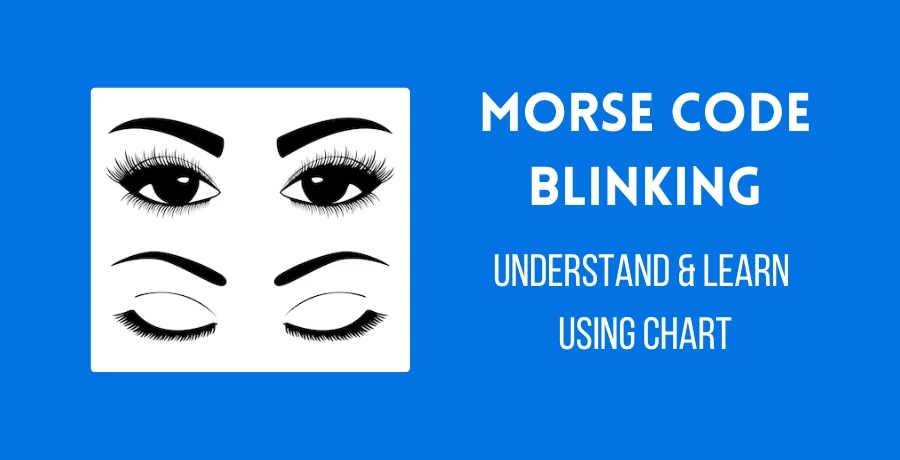
Morse code blinking is a method of sending Morse code messages using eye movements instead of sound or light. In this technique, a short blink represents a dot, while a longer blink represents a dash. By combining these blinks in specific patterns, a person can spell letters, words, and even full sentences.
This non-verbal communication method can be useful in situations where a person cannot speak or write. It has historical importance and is sometimes used in emergencies, medical communication, and survival scenarios. Learning Morse code through blinking can also help people understand how Morse code works in real-world situations.
The Historical Story Behind Morse Code With Eyes
One of the most famous examples of Morse code being transmitted through eye movements happened during the Vietnam War. In 1966, US Navy pilot Admiral Jeremiah Denton was captured and held as a prisoner of war.
During a televised interview arranged by his captors, Denton secretly used blinking to send a message in Morse code. While appearing calm on camera, he repeatedly blinked in a pattern that spelled the word “TORTURE.”
This blinking message was later decoded by US intelligence officials. It revealed that American prisoners were being tortured in captivity. Denton’s message became one of the most well-known examples of morse code with eyes being used as a hidden communication method.
Since then, Morse code blinking has been recognized as a clever and courageous way to send secret messages when normal communication is impossible.
Morse Code Blinking
In Morse code blinking, each blink represents a Morse code symbol.
- Short blink = Dot ( . )
- Long blink = Dash ( – )
By combining dots and dashes, letters can be formed. These letters can then create words and sentences.
For example, if someone wants to send the word HELP, the blinking pattern would be:
H: ….
Four short blinks
E: .
One short blink
L: .-..
Short blink, long blink, short blink, short blink
P: .–.
Short blink, long blink, long blink, short blink
Although this sequence works, many people prefer sending SOS because it is shorter and easier to blink quickly.
SOS blinking pattern:
S: · · · → three short blinks
O: — — — → three long blinks
S: · · · → three short blinks
SOS is widely recognized as an international distress signal and is easier to communicate through eye movements.
Understanding Morse Code Blinking
It is a way of communicating and transmitting singles using eye blinks. A short blink represents a dot, whereas a long blink represents a dash. This type of communication is useful when someone is unable to write or speak. For example, if someone wants to ask for help through blinks, he will use the given sequence:
- H: (….) four short blinks
- E: (.) one short blink
- L: (.-..) one short, followed by one long and then three short blinks
- P: (.–.) one short, two long and one short blink
Using SOS for help in morse code is easier than following the whole sequence of HELP in eye blinks. Therefore, if someone wants to blink SOS in morse code, he should use the following sequence:
- S: · · · three short blinks
- O: — — — three long blinks
- S: · · · three short blinks
You can translate english text into Morse code with the help of Morse Code Converter.
Blinking in Morse Code for Emergency Communication
Blinking in Morse code can be useful in situations where a person cannot speak or move freely. Because blinking requires minimal movement, it can still work even when other forms of communication are impossible.
Possible real-life uses include:
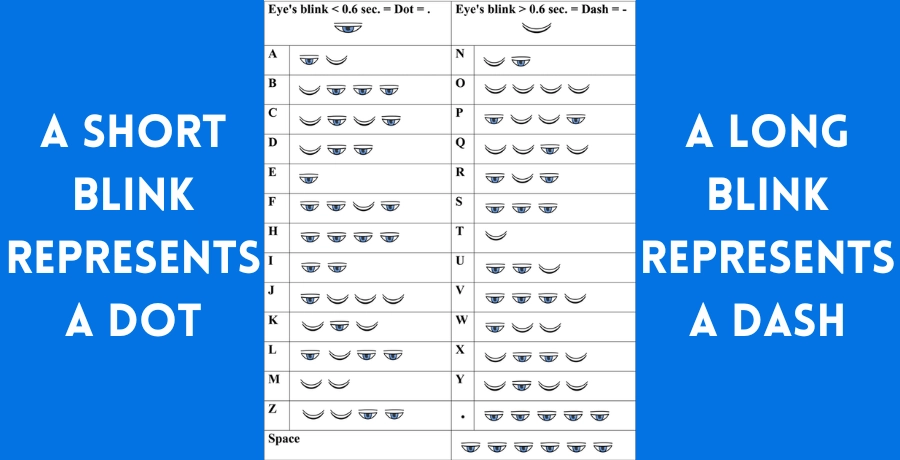
Morse Blinking Chart
In order to blink in Morse Code, you need to first understand and learn the blinking chart. It is a chart where each alphabet and letters have a corresponding blinking signal according to Morse code alphabet chart and offers visual guidance on how to communicate using eye blinks. A comprehensive chart of dots and dashes represented by eye blinks is given below.
Jeremiah Denton Blinking Morse Code
Jeremiah Denton, who was the first to blink torture using morse code as P.O.W used the following morse code sequence to spell Torture
- T: –
- O: —
- R: .-.
- T: –
- U: ..-
- R: .-.
- E: .
Learning Morse Code Blinking
- Familiarize yourself with the basics and go through the blink chart, which has alphabets and letters with their respective codes. For dot, blink short and for dash, blink longer.
- Start practicing with the short and easy letters, for example, E is just a dot, so you have to short blink once. T is a dash, long blink once. After learning the easy blinks move to the difficult one.
- Use a mirror to practice blinking and observe the gap between the blinks.
- Use resources such as online apps and videos as well as simulation tools for practice.
- Practice with your friend who is interested in learning.
Applications of Code Blinking
It has some real life applications and can be used in emergencies when a person can not write or speak. For example, Jeremiah Denton spelled “torture” in morse code by blinking. Some people can use the simplest code for help, which is SOS. Some patients who can not move or speak can also use morse blinking to convey their message. Or even simply, code blinking can be used by friends to communicate secretly.
Practical Applications of Morse Code With Eyes
Even though modern technology has replaced Morse code in most communication systems, it still has several useful applications.
Education
Teachers use Morse code to demonstrate early communication technology and problem-solving skills.
Amateur radio
Some radio operators still learn Morse code as part of traditional radio communication training.
Medical communication systems
Eye-based communication systems inspired by Morse code are sometimes used by patients with limited movement.
Survival training
Learning Morse code signals can help people communicate during emergencies when normal tools are unavailable. Because Morse code relies on simple signals, it remains one of the most flexible communication methods ever created.
Conclusion
Morse code blinking is a fascinating method of communication that allows messages to be transmitted using eye movements. By representing dots with short blinks and dashes with longer blinks, people can spell letters, words, and even full sentences.
This technique gained worldwide attention during the Vietnam War when Jeremiah Denton used blinking to secretly reveal that American prisoners were being tortured. Since then, Morse code blinking has become an important example of how communication can adapt even in difficult circumstances. Although it is rarely used as a primary communication method today, learning Morse code blinking can still be valuable. It provides insight into historical communication systems and may even help in situations where speaking or writing is impossible.