Modern Morse Code Numbers for Learning and Translating
Morse code numbers are an important part of the International Morse code communication system. They allow people to send digits from 0 to 9 using simple combinations of dots and dashes. These signals can be transmitted through sound, radio signals, blinking lights, or tapping patterns. Morse code numbers follow a clear pattern that makes them easier to memorize than many letters.
The number system in Morse code uses exactly five signals for each digit. These signals are made from short marks called dots and longer marks called dashes. Because every number uses the same number of elements, the structure is predictable and easy to learn with practice. Many radio operators, emergency communicators, and hobbyists still use these signals today.
Learning Morse code numbers helps you decode messages, understand timestamps in Morse communication, and practice real telegraph-style signaling. In this guide, you will learn the complete number system, practical ways to read it, and techniques that make memorization faster.
Morse Code Numbers 0 to 9
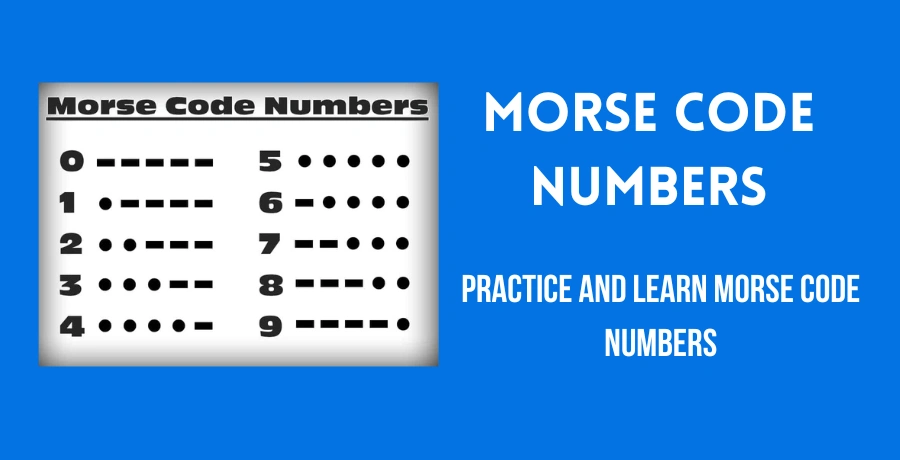
Every digit in Morse code has a unique pattern made from five signals. The system follows a logical order that helps learners recognize patterns quickly. Numbers from 1 to 5 start with dots and end with dashes, while numbers from 6 to 0 begin with dashes and end with dots.
Below is the full list of Morse code numbers.
| Numbers | Morse Code |
|---|---|
| 0 | —– |
| 1 | .—- |
| 2 | ..— |
| 3 | …– |
| 4 | ….- |
| 5 | ….. |
| 6 | -…. |
| 7 | –… |
| 8 | —.. |
| 9 | —-. |
| 10 | .—- —– |
How to Read Morse Code Numbers
Understanding how to read Morse code numbers requires learning the difference between dots and dashes and recognizing signal timing.
A dot is a short signal.
A dash is a longer signal that lasts about three times as long as a dot.
When decoding Morse code numbers, you should focus on the pattern rather than counting each signal individually. For example:
- …– instantly represents the number 3 once you recognize the three dots followed by two dashes.
- —-. represents 9, which begins with four dashes and ends with a dot.
Another important part of reading Morse numbers is spacing. Small pauses separate signals within a number, while longer pauses separate different characters. Beginners often try to count dots and dashes one by one. A better approach is to learn the overall pattern so your brain recognizes the number immediately.
How to write numbers in Morse code?
- Only single digit number, that is, from 0 to 9, are represented by code.
- Zero is entirely in dashes (5 dashes). ➖➖➖➖➖
- Moving to one adds a dot instead of a dash in the beginning. So, 1 has a dot and 4 dashes. ・➖➖➖➖
- Moving to the next digits, dashes are replaced by dots, and finally, 5 is represented entirely by dots (5 dots). ・・・・・
- Moving to 6, the first dot is replaced by a dash. ➖・・・・
- The same rule applies to other subsequent numbers, such that each dot is replaced by a dash.
- Moving to double-digit numbers, for example, for 55 write code for five two times.
How to Learn Morse Code Numbers Quickly
Many beginners ask how to learn Morse code numbers quickly. The key is pattern recognition rather than memorizing ten separate codes.
Here are practical methods that work well.
Learn the Pattern First
Instead of memorizing each number individually, remember the rule:
Numbers 1 to 5 add dots.
Numbers 6 to 0 add dashes.
Once you understand this structure, the system becomes logical rather than random.
Practice Counting Signals
Listen to Morse signals and count the first few elements.
For example:
- If the signal starts with three dots, the number is likely 3.
- If the signal starts with three dashes, the number is likely 8.
Use Flashcards
Flashcards help your brain connect the digit with its signal pattern.
Example card:
Front: 7
Back: –…
Practicing a few minutes daily can help you memorize all the numbers in less than a week.
Practice with Audio
Listening to Morse signals improves recognition speed. Many learners find audio training easier than visual memorization.
When are morse numbers used?
- It is used to share personal credentials and information such as bank account numbers, date of birth or phone number. This is specifically helpful in situations when you want to secretly pass the message.
- IT industries may use telegraph code to communicate with companies using telegraph code so that the information is kept safe from hackers. Number codes are used to hide details from the attackers.
- Some may use it as a method to secretly share passwords and OTPs for security reasons.
- Others may use it as a fun way to exchange number codes with friends to be decoded, or use it as a tattoo.
Practical Uses of Morse Code Numbers
Numbers play an important role in Morse code communication. Many real-world messages depend on them.
Radio Communication
Amateur radio operators frequently transmit numbers such as frequencies, signal reports, and coordinates.
Example:
Signal report
599
In Morse code this becomes:
….. —-. —-.
Navigation and Coordinates
Emergency and maritime signals sometimes include coordinates that contain several digits.
Example location format:
24.8607 N
67.0011 E
Numbers help transmit precise geographic information during rescue operations.
Military and Aviation Communication
Historically, Morse code numbers were used to transmit:
- mission codes
- map references
- radio frequencies
Even though modern digital systems replaced many Morse transmissions, the system remains part of radio training and emergency communication.
Conclusion
Morse code numbers form a simple but powerful part of the Morse communication system. Each digit uses five signals made from dots and dashes, creating a symmetrical structure that is easy to learn. Once you understand the pattern that connects numbers from 1 to 0, memorization becomes much easier.
Learning these number patterns helps with decoding real Morse messages, especially in radio communication and emergency signaling. With regular practice, most learners can recognize all Morse digits quickly. Start by memorizing the central number 5, then expand outward to the rest of the sequence. Within a short time, Morse code numbers will become second nature.