Morse Code Alphabet A to Z: Complete Chart and Learning Guide
The morse code alphabet is a system of communication that represents letters using sequences of dots and dashes. It was created in the 19th century to transmit messages through telegraph wires. Each letter has a unique pattern that allows operators to send messages without spoken words.
Dots are short signals, and dashes are longer signals. Letters are separated by short pauses, while words are separated by slightly longer pauses. This system can be transmitted using sound, flashing lights, radio signals, or morse code tapping.
Learning the Morse code alphabet helps beginners read and send messages, understand historical communication, and practice pattern recognition. The system remains valuable for amateur radio and emergency signaling.
Morse Code Alphabet
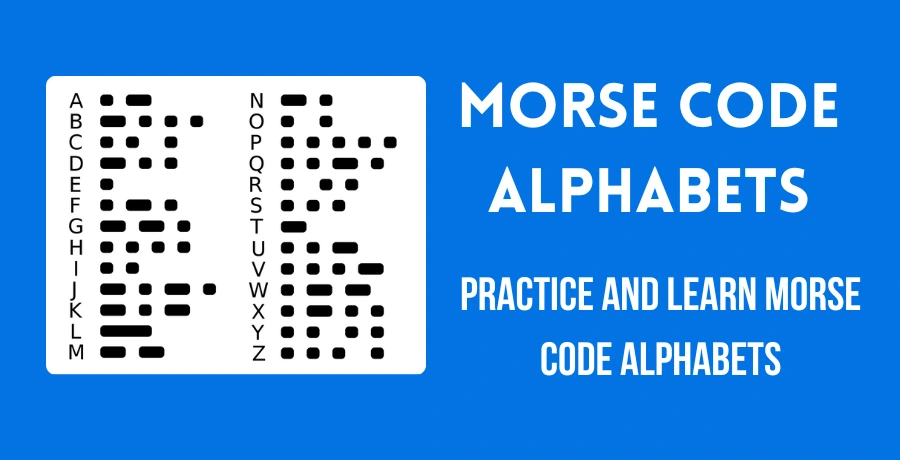
Morse code letters and alphabet consist of a table consisting of 26 letters, which is also called the international morse code alphabet. An extensive alphabet chart is given below.
| Alphabet | Morse Code | Alphabet | Morse Code | Alphabet | Morse Code |
|---|---|---|---|---|---|
| A | .- | J | .— | S | … |
| B | -.. | K | -.- | T | – |
| C | -.-. | L | .-.. | U | ..- |
| D | -.. | M | – | V | …- |
| E | . | N | -. | W | .– |
| F | ..-. | O | — | X | -..- |
| G | –. | P | .–. | Y | -.– |
| H | …. | Q | –.- | Z | –.. |
| I | .. | R | .-. |
History of the Morse Code Alphabet: From Telegraphs to Modern Use
The Morse code system was developed by Samuel Morse and Alfred Vail in the 1830s. Originally, it only transmitted numbers, which operators looked up in codebooks. Later, it was expanded to include letters, creating the first complete alphabet communication system.
The International Morse code standard was established to unify communication across countries. Ships, railroads, and military used Morse extensively. Even today, Morse code remains part of emergency signaling and amateur radio practice.
Understanding its history gives learners context and helps them appreciate why the alphabet is structured the way it is.
Reading and learning morse code words
- Get started by familiarising yourself with the alphabet tapping and their basic units. The building blocks are the dits and dahs also known as dots and dashes.
- Use visual and auditory cues to associate each alphabet with the corresponding code. For example, you can use flashcards to enhance memorisation.
- Use different online resources such as educational videos on learning alphabets and codes, apps and softwares to better understand how to read Morse code.
Timing Rules for Dots, Dashes, and Letter Spacing
Correct timing is critical in Morse code.
- A dot lasts one unit of time
- A dash lasts three units
- Space between letters is three units
- Space between words is seven units
Timing ensures messages are clear and readable. Without proper spacing, signals can be misinterpreted.
Phonetic Alphabet Integration With Morse Code Letters
The phonetic alphabet reduces confusion in radio transmission. For instance:
- A = Alpha
- B = Bravo
- C = Charlie
This morse code alphabet phonetic system is often paired with Morse signals for clarity. Beginners searching for morse code alphabet alpha bravo will find it essential for real communication.
Morse Code Alphabet in Different Languages
Morse code adapts to other scripts, such as Arabic. Learning the morse code alphabet Arabic variant, allows non-English speakers to communicate.
The signal method remains consistent, ensuring international compatibility in emergencies and amateur radio.
Significance of Morse Code
Today it might not be the primary mode of communication but in the past, it was used to inform people about the war, to keep each other informed of the situation and keeping families together. It was because this method was fast, simple and effective. Today many Naval intelligence agencies require trainees to learn this method for emergency situations. This method is advantageous due to its low requirement for the technology and its ability to work over the vast distances. Some people also learn it as a hobby and a skill that they think might be helpful some day. For example, in the past for emergency situations SOS message was sent through code which was represented as “…—-…”.
Smart Tricks to Remember the Morse Code Alphabet Faster
Using memory aids speeds learning of the Morse code alphabet. These tricks help beginners retain letters and signals:
Use Word Associations and Mnemonics
Associating letters with words or images creates a mental connection. For example, A (dot dash) could be remembered as “apple swing.”
Learn by Listening to Audio Patterns
Hearing patterns reinforces recognition. Beginners often learn faster with repeated listening sessions.
Visualize Morse Signals for Better Memory
Picture dots and dashes on paper or in your mind. Visualization aids recall during real-time decoding.
Group Similar Letters Together
Learning letters with similar patterns as a group reduces confusion and improves speed.
Tap and Flash Practice Exercises
Use tapping or flashlight exercises to practice Morse code hands-on. This method helps in situations without sound or radio.
Practice with Beats or Rhythms
Reciting signals to a steady rhythm improves accuracy and speed in sending and receiving.
Revisit and Test Yourself Frequently
Repetition is key. Daily short sessions work better than long infrequent practice.
Conclusion
Morse code used to be an effective and efficient method of communication in the past due to its simplicity. It works by sending signals in the form of dots and dashes, which are later converted into the original message. The International Code for English letters is a chart of 26 letters, each having a corresponding code. The combination of these codes makes a message shorter or longer. For those who can’t memorise the whole chart of alphabets and letters, a free morse code converter can be used, which is an online platform that decodes the code into text.