When Was Morse Code Invented – History, Purpose, and Legacy
Morse code is one of the most transformative inventions in the history of communication. Before telephones and the internet, transmitting messages over long distances was slow and unreliable. The invention of Morse code allowed information to travel instantly over telegraph lines, revolutionizing commerce, governance, and personal communication. Understanding when was Morse code invented is not just a matter of historical curiosity. It reveals how early innovators tackled challenges of speed, accuracy, and efficiency. Even today, Morse code has practical applications in emergency signaling, aviation, and hobbyist radio operations. Its simplicity—using only dots and dashes—made it accessible and enduring, laying the foundation for modern communication systems.
Why Was Morse Code Invented
In the early 1800s, long-distance communication relied entirely on horses, ships, or messengers. Messages were slow, unreliable, and often subject to errors or delays. Governments, businesses, and military operations needed a faster, more secure method. The invention of the telegraph created the opportunity for electrical signaling, but there needed to be a simple system to translate letters and numbers into signals. Morse code provided that solution: a method to send letters, numbers, and even punctuation using dots and dashes that could travel over wires. Its invention transformed society, allowing news, financial information, and emergency signals to move faster than ever.
The Birth of Morse Code: Early 1800s
The development of Morse code began with Samuel Morse invention, later refined by Alfred Vail. Morse initially designed the telegraph system to send electrical pulses over long distances. Vail’s engineering expertise helped standardize the coding of letters and numbers into patterns of short and long signals. Their collaboration resulted in a practical, reliable system that could be quickly learned by telegraph operators. What began as a simple experiment became a cornerstone of 19th-century communication, laying the groundwork for global telegraph networks.
The First Morse Code Message
The first official Morse code message was sent on May 24, 1844, from Washington, D.C., to Baltimore. The message, “What hath God wrought,” was transmitted through the new telegraph line and received perfectly at the other end. This event marked the dawn of modern communication. The success of the message convinced governments and businesses to invest in telegraph networks, which expanded rapidly across the United States and Europe. The First Morse code message is remembered today as a turning point in technological innovation and global connectivity.
How the Original Morse Code Worked
Morse code uses a series of dots (short signals) and dashes (long signals) to represent letters, numbers, and punctuation. Each letter has a unique combination, such as A = .- and B = -…. Early operators mastered these patterns by listening to the clicks of telegraph machines. Over time, American Morse code was developed for domestic telegraphy, while International Morse code became the global standard for radio communication. This system was simple, reliable, and could be transmitted using electrical signals, sound, or light flashes, making it useful in many situations. For example, people can even send signals visually by blinking their eyes, which you can learn in this guide on how to blink in Morse code.
Morse Code Timeline
- 1830s: Morse code was invented by Samuel Morse and Alfred Vail.
- 1844: First official message sent.
- 1850s: Telegraph networks rapidly expand across the U.S. and Europe.
- 1900s: SOS standardized as a universal distress signal.
- 1930s–1940s: Widely adopted in aviation and military communication.
- Modern Era: Hobbyists, emergency signaling, and educational uses.
This Morse code timeline shows how the system evolved from a simple experiment to a global communication tool.
Morse Code in Telegraph, Aviation, and Military Communication
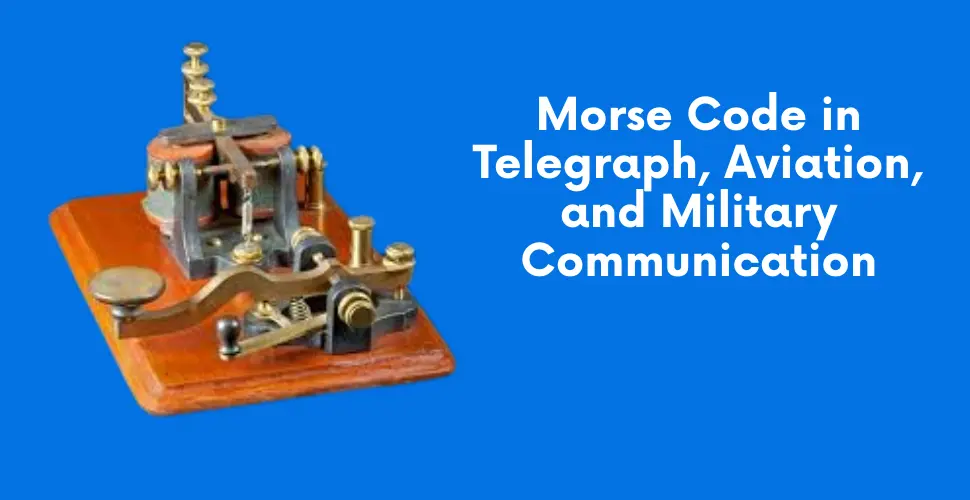
Morse code transformed telegraph communication by making messages almost instantaneous. In aviation, pilots relied on it to transmit flight instructions and emergency messages when voice radios were unreliable. The military used Morse code for secure communications, battlefield coordination, and coded dispatches. Even today, understanding these applications highlights Morse code’s reliability. The SOS signal (… — …) is still recognized worldwide, showing how emergency communication depends on patterns that were first standardized over 150 years ago.
Standardization: American vs International Morse Code
Initially, the U.S. used American Morse code, which had variations in timing and symbols. As telegraphy expanded internationally, a need arose for consistency. International Morse code became the global standard, simplifying long-distance and cross-border communication. Its adoption made Morse code accessible for radio operators worldwide and ensured that messages could be understood regardless of location. Understanding the differences is crucial for anyone studying Morse code history or practicing it today.
Morse Code Innovations and Tools
Early Morse code innovations included telegraph machines, mechanical decoders, and sounders that produced audible clicks for operators. Modern technology has introduced morse code generator apps, morse code translator tools, and audio playback to practice efficiently. These tools allow beginners and hobbyists to send, receive, and decode messages without physical telegraph lines, making Morse code accessible to anyone interested in learning its patterns.
Morse Code in Modern Times
Even in the digital era, Morse code has practical relevance. It is used for emergency signaling, survival situations, and amateur radio. Students and hobbyists often practice phrases like i love you in morse code or help me in morse code to understand timing, patterns, and accuracy. Techniques like morse code blinking with lights are also employed in training and survival courses. Despite technological advances, the simplicity and reliability of Morse code ensure it remains a valuable skill.
Fun Facts and Historical Anecdotes
- The SOS distress signal was standardized for its simplicity: three short, three long, three short signals.
- Morse code influenced early computing, inspiring binary-like digital signaling.
- Its first major messages helped newspapers transmit news faster than ever, revolutionizing journalism.
- Morse code appears in pop culture, games, and survival training exercises even today.
Impact on Communication and Technology
Morse code was the first widely adopted electrical signaling system. It influenced early computer coding, radio communication, and digital signaling. The logic of dots and dashes is foundational to understanding binary systems and modern telecommunication. Studying Morse code provides insight into the evolution of information technology and shows how simple innovations can shape the future.
Conclusion
Morse code, invented by Samuel Morse and Alfred Vail in the early 1800s, revolutionized global communication. From telegraph networks to aviation and military communication, it enabled rapid, reliable, and secure messaging. Modern tools like morse code translator apps make it easy to learn and apply today. Understanding its history, timeline, and applications highlights the lasting impact of a simple system of dots and dashes. Morse code is more than a historical artifact—it is a window into how innovation reshapes society.