Morse Code Titanic: How SOS Signals Changed Maritime Communication Forever
In the early 1900s, ocean travel was an adventure filled with promise and peril. Ships moved people and goods across continents, but communication between vessels and shore stations was limited and slow. That changed with the advent of Morse code on ships, which allowed wireless messaging across vast distances using radio telegraphy. Nowhere was this more evident than during the tragic sinking of the RMS Titanic in 1912. When the Titanic struck an iceberg and began to sink, its crew turned to wireless Morse code distress signals to call for help. Those signals not only alerted nearby ships but also became one of the most pivotal life‑saving technologies in maritime history.
This article explores how morse code titanic, explains why the distress signals mattered, and shows how this system reshaped global maritime safety regulations. We’ll also unpack the technical details, human stories, and long‑term legacy of Morse code in emergencies at sea.
Wireless Telegraphy and Ship Communication in the Early 1900s
Before wireless communication, ships had no reliable way to alert distant stations or vessels in an emergency. Visual signals, flags, and lights worked only at close range. The development of wireless telegraphy—radio systems that could transmit signals without wires—revolutionized ship communication. Morse code became the standard language for these messages because it was simple, efficient, and effective over long distances.
Wireless operators aboard ships used Morse code to send and receive text‑based messages in the form of dots and dashes. These signals could travel hundreds of miles over the ocean, making it possible to share weather reports, coordinate navigation, and deliver urgent warnings. By the time the Titanic set sail in 1912, many transatlantic liners were already equipped with wireless telegraph systems. These systems would prove vital when disaster struck.
The Titanic’s Wireless Telegraph System
The Titanic was fitted with a state‑of‑the‑art Marconi wireless system operated by a team of trained telegraph operators. Their primary role was to send passenger messages to shore and receive information from other ships. Onboard, they used Morse code to encode text into signals that could be transmitted over long distances.
The two main wireless operators on the Titanic were Jack Phillips and Harold Bride. They worked long hours handling routine messaging and relaying information about passengers. Morse code was their everyday tool, a system that had been widely used since the period when Morse code was first introduced, as explained in the history of when Morse code was invented. Their skill with the telegraph would become crucial once the Titanic began to sink.
The Iceberg Collision and Immediate Response
On the night of April 14, 1912, the Titanic struck an iceberg in the North Atlantic. The collision damaged the ship’s hull, leading to rapid flooding. As the vessel began to list, the need for emergency communication became urgent. The radio operators immediately began sending distress signals using Morse code.
At this time, maritime Morse code distress signals had already begun to transition from older codes to newer standards. The operators sent both CQD (an early distress call meaning “come quick, distress”) and the newer SOS signal. The SOS signal—three dots, three dashes, and three dots (… — …)—was gaining prominence because of its simplicity and ease of recognition.
CQD and SOS: The Distress Signals of the Titanic
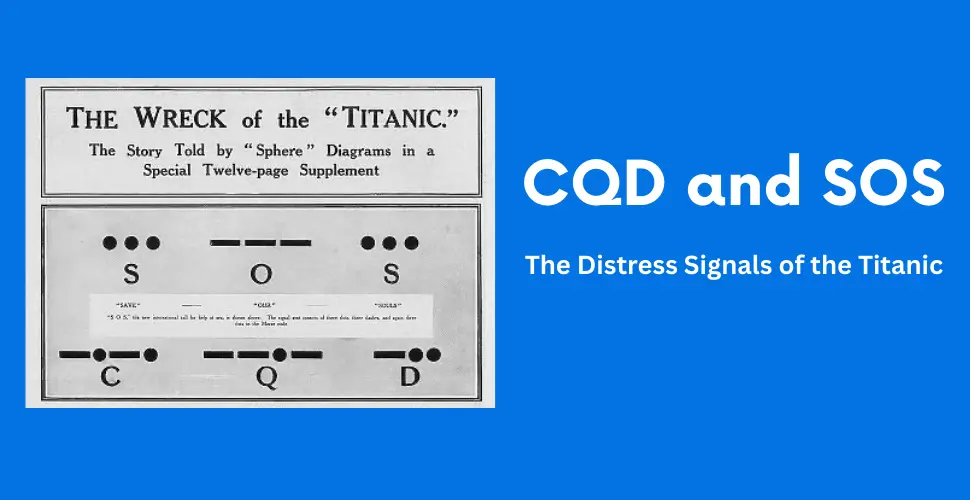
During the disaster, both distress codes were transmitted in Morse code; this reflects the transitional period of maritime signaling standards at that time. The CQD signal was still widely understood, but SOS was rapidly becoming the international choice due to its distinct pattern and lack of ambiguity.
The Titanic’s operators sent distress messages continuously throughout the night. These included the ship’s position coordinates and repeated distress signals. Because the signals were transmitted in Morse code, they could reach radio operators far beyond visual range, allowing for emergency response coordination with nearby vessels.
How Morse Code Reached Rescue Ships
One of the most critical outcomes of transmitting Morse code signals from the Titanic was reaching the RMS Carpathia, a passenger liner located miles away. Despite the freezing ocean and the chaos onboard, the repeated SOS and CQD signals were picked up by Carpathia’s radio operator.
Upon receiving the messages, Carpathia immediately changed course and steamed toward the Titanic’s last known position. Thanks to Morse code communication, the rescue ship arrived in time to pull survivors from lifeboats as dawn approached.
Without wireless Morse code, the Titanic’s distress calls would have been limited to visual or auditory signals that could only reach nearby vessels—if any were within sight. Morse code dramatically expanded the radius of potential rescue help and saved hundreds of lives.
Limitations and Lessons from the Titanic Disaster
The Titanic tragedy also exposed limitations in existing maritime communication systems. Some of these were:
- Inconsistent 24‑hour monitoring: Not all ships monitored wireless Morse code channels around the clock, meaning distress calls could be missed.
- Operator overload: In emergencies, operators could become overwhelmed with signal traffic, slowing down communication.
- Lack of standardized protocols: The use of both CQD and SOS showed that uniform global standards were not yet fully adopted.
These weaknesses led to important reforms. After the disaster, international maritime agencies mandated 24‑hour monitoring of distress frequencies and the exclusive use of SOS as the standard distress signal. These changes ensured that no ship in distress would go unheard simply due to timing or inconsistent practices.
Everyday Life After the Titanic: Morse Code’s Legacy
In the years following the Titanic sinking, Morse code maintained its position as an essential communication tool. Ships around the world adopted standardized distress protocols. Wireless telegraph operators became a recognized profession, trained specifically to handle emergency and routine messages.
Beyond maritime use, Morse code’s simplicity and efficiency inspired early wireless communication standards that paved the way for modern digital signaling. It influenced how text data could be encoded, transmitted, and decoded—ideas now foundational in telecommunications.
Fun Facts from the Titanic’s Wireless Room
- The Titanic’s operators sent hundreds of messages on the night of the disaster, both distress and routine.
- Survivors on lifeboats reported hearing Morse code distress signals long after the ship went down.
- The disaster accelerated the creation of the International Convention for the Safety of Life at Sea (SOLAS), which formalized global maritime safety rules.
These anecdotes show how Morse code was not just a technology but a lifeline that mattered deeply in real human stories.
Modern Relevance Today
Even with satellite communication, digital texting, and automated distress beacons, Morse code remains a powerful symbol of emergency signaling. Its universal pattern—especially the SOS signal—is still recognized worldwide. Amateur radio operators practice Morse code as a hobby and for emergency preparedness. Studying Morse code today offers insight into the roots of wireless communication and the human ingenuity that shaped it.
Conclusion
The story of the Morse code Titanic drama is more than a historical footnote. It shows how a simple signaling system of dots and dashes could mean the difference between hope and tragedy. The Titanic disaster underscored the need for reliable communication and led to reforms that saved countless lives in the decades that followed. Despite being over a century old, Morse code’s legacy endures in maritime safety, emergency protocols, and wireless communication fundamentals. Its role in history reminds us that even the simplest technologies can have profound impacts when lives are on the line.